Awareness above the perimeter
The sky is part of the event environment
Event plans account for gates, fencing, crowds, vehicles, contractors and emergency access. Drone activity adds another moving element—one that may approach from beyond the physical perimeter and may not be obvious to staff on the ground.
Most drone flights have an innocent explanation. The useful question for an event team is not whether every drone is a threat, but whether unexpected activity can be noticed, time-stamped and understood early enough to support a calm, proportionate response.
Australian Government policy work identifies major events and crowded places among the environments where broader drone security risks deserve attention. DroneDingo is designed to add practical awareness, not alarm.
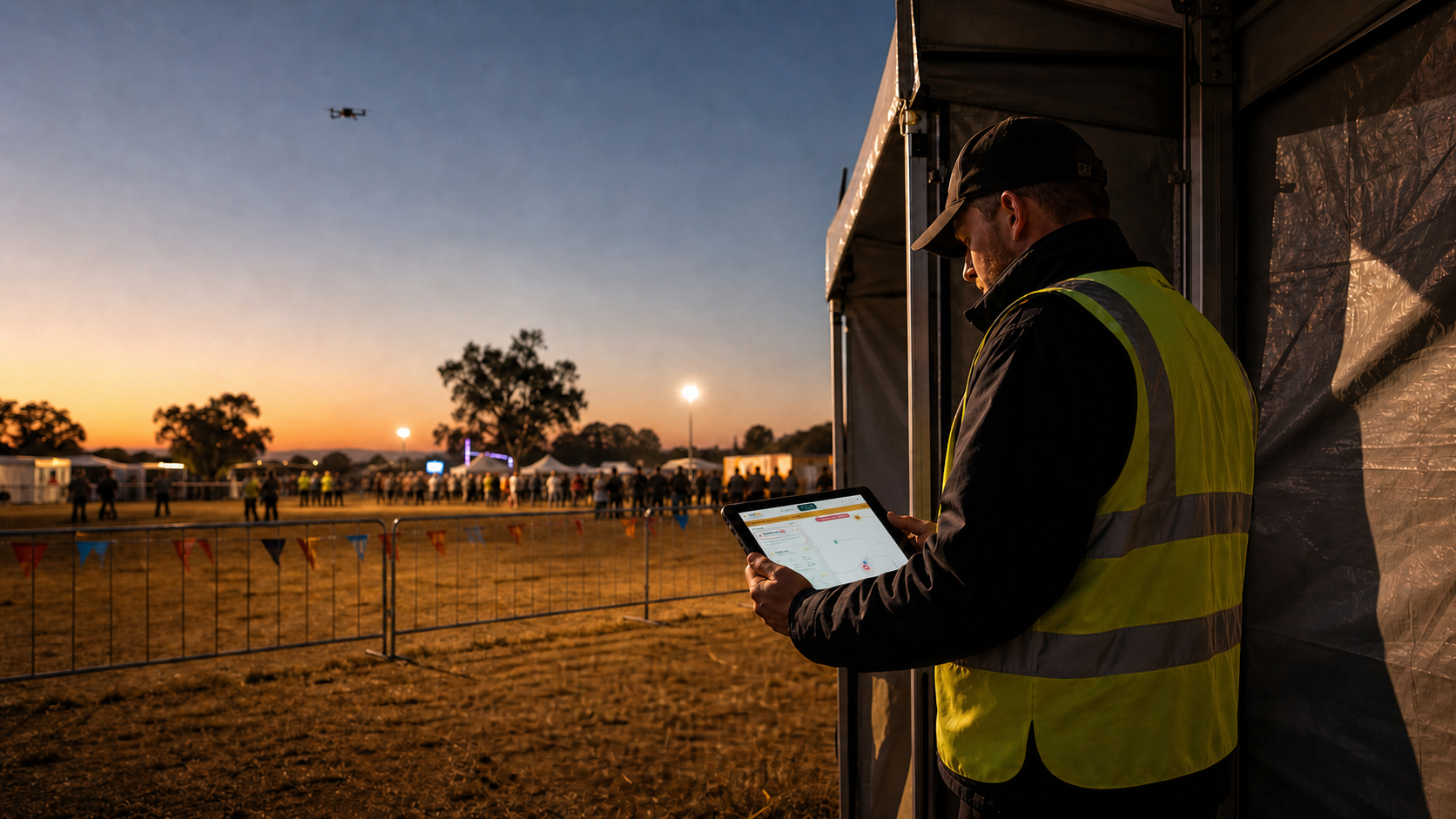
Portable by design
Set up quietly. Monitor continuously. Pack down cleanly.
A temporary event should not require permanent infrastructure. A DroneDingo deployment can be planned around event control, a security office, a media compound or another protected operating position with a useful view of the surrounding sky.
- Self-contained: a dedicated appliance designed to perform one job without a rack of specialist equipment.
- Discreet: positioned within the event operation rather than becoming a public-facing attraction.
- Locally accessible: authorised staff can view the console from a computer, tablet or phone browser on the same network.
- Connection-aware: the live console and included offline maps can continue locally without internet. Internet connectivity is required for alerts, and only the information needed to deliver those alerts is shared.
- No ongoing subscription fee: a practical asset that can be used across suitable deployments.
Useful information, honestly presented
Identified aircraft—and suspected activity when identity is unavailable
When a mainstream commercial drone broadcasts usable identification and flight information, DroneDingo can present the details available, such as aircraft identity, position, height, speed, direction, observed path and operator information where broadcast.
Cheaper or unidentified aircraft may not provide that complete picture. DroneDingo can also recognise unknown radio activity with characteristics consistent with possible drone operation and report it as suspected drone activity. It does not invent a serial number, flight path or operator location when those details are not available.
That distinction matters at a public event. It gives an operator a useful signal while keeping uncertainty visible, supporting verification through staff observations, cameras and the event communications plan.
Potential deployments
Where an extra layer of awareness may help
Shows, festivals and outdoor concerts
Unexpected activity near a crowd, stage, pyrotechnics zone or temporary structure can be logged and brought to the attention of event control.
Sporting and motorsport events
Monitor activity near spectator areas, pits, tracks, emergency corridors and broadcast operations, where an unauthorised aircraft may complicate an already busy environment.
Regional field days and agricultural events
Add airspace context across large showgrounds containing valuable displays, machinery, livestock, exhibitors and temporary access routes.
Temporary public-safety operations
Provide a shared live view and sighting history for an authorised team working from a temporary command point, without requiring every staff member to understand radio data.
Information supports the plan
Detect. Verify. Record. Escalate appropriately.
- Plan: nominate where the unit will operate, who watches it and how a sighting enters the event communications process.
- Detect: the appliance passively observes supported broadcasts and relevant radio activity. It does not transmit toward, jam or take control of an aircraft.
- Verify: compare the alert with authorised event flights, visual observations and other security systems.
- Record: retain the time and information available so the event team has a clearer account of what occurred.
- Escalate: follow the event plan and contact police or the appropriate authority when activity appears unsafe or unlawful. DroneDingo does not replace emergency services, aviation authorities or trained security judgement.
Responsible capability
Awareness is not interdiction
DroneDingo is a passive awareness product. It cannot determine a pilot’s intent, guarantee detection of every aircraft, prevent a flight or authorise an event team to interfere with a drone. Detection conditions vary with aircraft, signals, terrain, structures, placement and local radio conditions. Product configuration and portable-deployment arrangements remain subject to field validation.
Event organisers should obtain current site-specific advice and check CASA, state, territory and local requirements. Rules and temporary restrictions may differ between events and locations.
A calmer view of what is happening overhead
Add airspace awareness to the event security plan
Tell us about the venue, operating period and event-control setup. We can discuss a responsible trial or prospective portable deployment without publishing sensitive operational details.