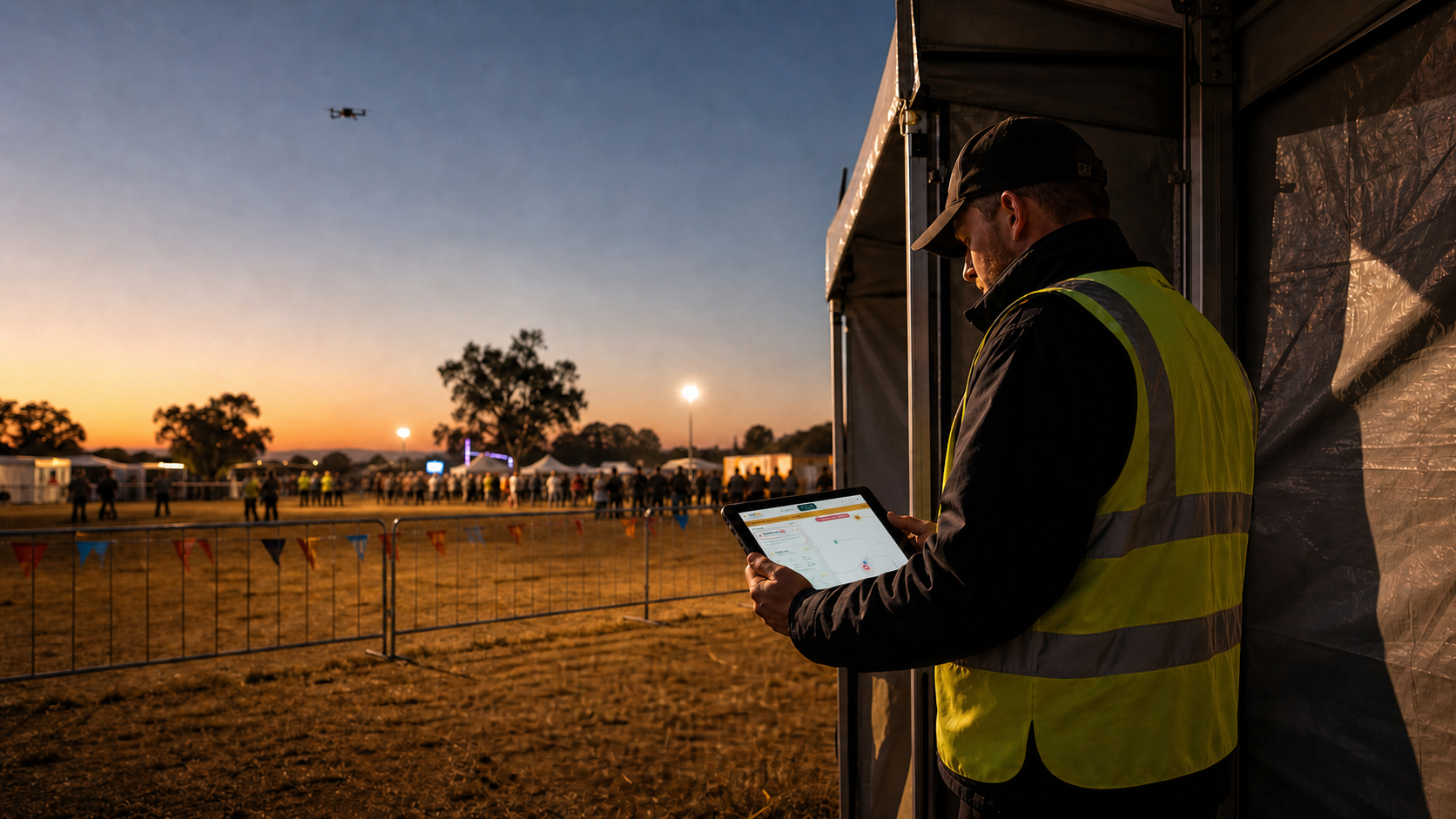
Public events are temporary by nature, but the responsibility carried by organisers is immediate. A festival, show, sporting fixture or outdoor concert can bring thousands of people, contractors, vehicles, temporary structures and competing operational priorities into one place. Security teams work hard to understand movement through gates and fences. Increasingly, there is another direction worth including in that picture: overhead.
Drones are useful tools. They support photography, broadcasting, emergency management, surveying and many legitimate commercial activities. That is exactly why an event-security plan should avoid treating every aircraft as hostile. The goal is not to create fear. It is to make unexpected activity easier to notice, verify and record, so the people responsible for the event can respond with context rather than guesswork.
A perimeter that does not end at the fence
Physical security is built around visible boundaries. Staff can control a vehicle gate, check credentials at an entrance and monitor a restricted compound with cameras. A small aircraft can approach from outside those boundaries and may be difficult for ground staff to locate against a bright sky, stage lighting or a busy visual background.
An unexpected drone may be a visitor making a poor decision, a contractor operating without advising event control, a media aircraft in the wrong place, or activity that deserves closer attention. Detection alone cannot reveal intent. It can, however, create an earlier prompt: something may be operating nearby; here is the time; here is the information available; now check it against the authorised-flight list and the event plan.
This is consistent with the direction of Australian Government policy. Government material recognises that off-the-shelf drones are becoming more capable and accessible, and identifies security and safety risks for government, business and the community. Major events, crowded places and sensitive sites feature directly in current drone-security policy discussions. That does not mean every event requires the same response. It means airspace awareness is becoming a legitimate planning question.
What a discreet portable deployment looks like
Event equipment needs to arrive, work and leave without becoming a project of its own. A potential DroneDingo event deployment is built around a self-contained appliance placed in a protected operational location: event control, a security office, a temporary command post or another position selected during planning. It does not need to sit at a public entrance or announce itself to attendees.
Authorised personnel can access the live console using a normal web browser on a computer, tablet or mobile device connected to the local network. No internet connection is required to use the local console or included offline maps. Internet connectivity is required when remote alerts are wanted, and the design shares only the information necessary to deliver those alerts.
This separation is valuable at temporary sites. The local view remains useful even when internet service is congested or unavailable, while a connected deployment can send timely alerts to nominated staff. There are no ongoing subscription fees simply to operate the appliance.
Two honest levels of information
DroneDingo is designed to be clear about what the receiver actually knows. When a mainstream commercial aircraft broadcasts usable identification and flight information, the interface can present the details available. Depending on the broadcast, that may include aircraft identity, position, height, speed, direction, observed route and operator information.
Not every aircraft provides that complete picture. Some cheaper or unidentified drones may produce radio activity that is consistent with drone operation without broadcasting reliable identity or telemetry. In that situation, DroneDingo can report suspected drone activity while making the uncertainty obvious. It does not manufacture a serial number, map position or operator location that was never received.
For event control, this prevents a vague radio indication from being presented as certainty. A suspected detection can be checked against visual observers, authorised pilots, CCTV and reports from staff. A richer identified detection can provide additional context. Both can be useful when their limitations are understood.
Four situations where context can matter
A regional showground
Agricultural shows and field days combine crowds, animals, machinery, exhibitors, vehicle movements and temporary facilities. If an aircraft is detected near a livestock area or demonstration zone, event control can check whether it belongs to an authorised photographer and record the activity if it does not.
An outdoor concert or festival
Stages, lighting towers, pyrotechnics, food areas and dense crowds create an environment where uncoordinated flight may introduce unnecessary risk. An alert can help the operations team start verification while maintaining normal crowd management, rather than relying on a chance sighting.
A sporting or motorsport fixture
Tracks, pits, spectator areas, medical access and broadcast aircraft may all have different operational needs. A time-stamped view can help distinguish an expected production flight from unexpected activity and support communication with the appropriate authority.
A recurring pattern around setup or pack-down
Public access may finish while valuable equipment remains onsite. Repeated activity during contractor arrivals, cash-handling periods or overnight pack-down does not prove criminal intent, but a sighting history can add useful context when compared with gate logs, cameras or subsequent incidents.
Building it into the response plan
Technology is most useful when someone knows what to do with its output. Before deployment, the organiser should nominate who monitors alerts, maintain a list of authorised drone operations and decide how information will be communicated. Staff should understand that a detection is an observation, not an accusation.
When an alert appears, the team can verify it against known activity, seek visual confirmation where safe, retain the available record and follow the established escalation path. If activity appears unsafe or unlawful, the appropriate police or aviation authority should be contacted. Staff should not attempt to jam, seize, pursue or interfere with an aircraft.
DroneDingo itself is passive. It listens for supported broadcasts and relevant radio characteristics; it does not transmit toward, command or disable a drone. This keeps its purpose straightforward: improve awareness and preserve context.
Know the rules for the particular event
National aviation-safety rules apply across Australia, while state, territory, council, venue and event-specific requirements may also apply. Government guidance recommends checking local rules carefully, particularly for concerts, sporting events and other special events, and checking again because restrictions can change.
A detection system does not create an authority to interfere with an aircraft. Counter-drone disruption capabilities are tightly controlled and are not what DroneDingo provides. Organisers should obtain current, site-specific guidance and ensure the response plan aligns with the relevant authorities.
A practical extra layer—not a replacement for people
No detector can guarantee that every drone will be seen. Results depend on the aircraft, the signals it emits, receiver placement, buildings, terrain and local radio conditions. Nor can a detection tell an event team why a pilot is flying. Those limitations should be stated plainly.
The potential value is more grounded: a discreet appliance can watch continuously while staff focus on the event; a live browser view can make detections understandable; and a sighting record can help reconstruct what happened. Used alongside trained security personnel, communications, CCTV, access control and a clear escalation plan, that can provide a calmer and more complete picture of the event environment.
DroneDingo is being written and developed in Australia with this practical approach at its centre. Portable public-event deployment remains a prospective use case subject to configuration and field validation, but the mission is already clear: turn activity overhead into useful, honestly presented information for the people responsible for safety on the ground.